Disaggregation With Multiple Maps
Source:vignettes/multiple-maps-schematic.Rmd
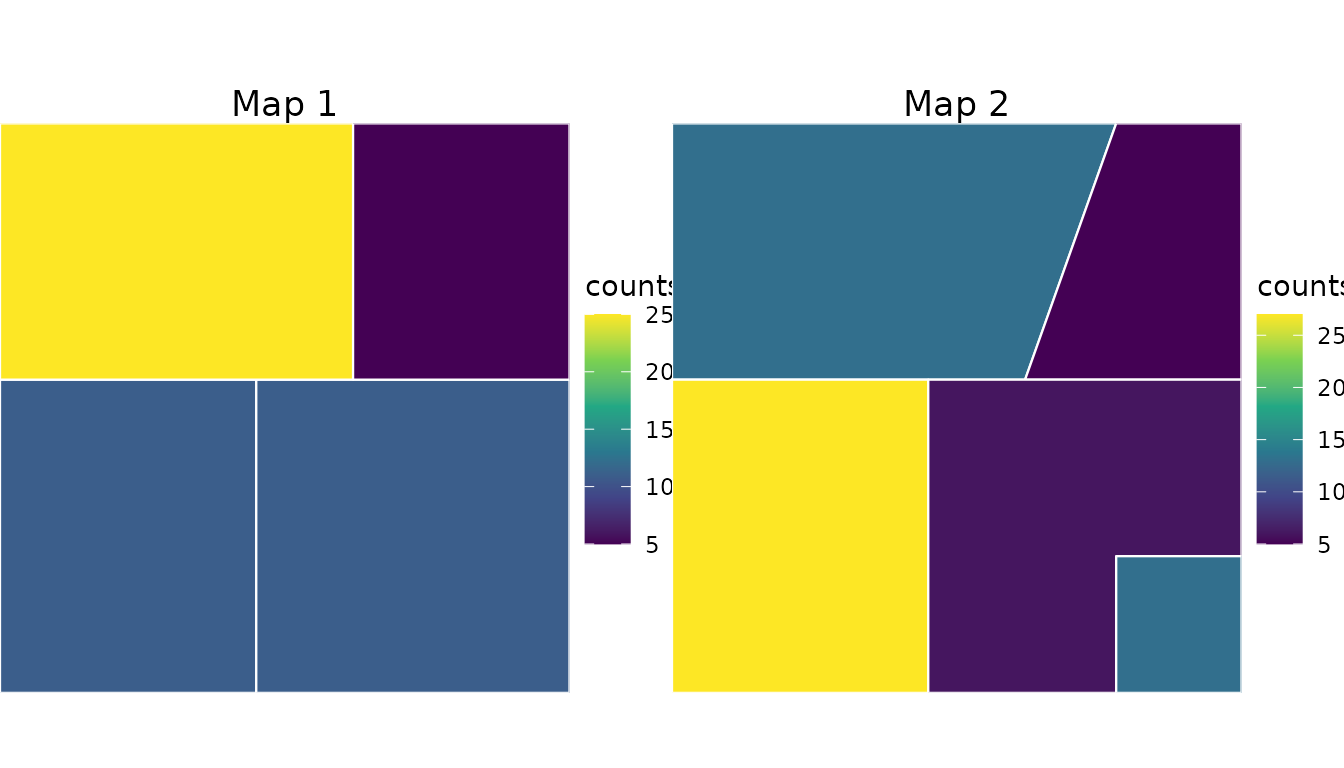
multiple-maps-schematic.RmdThis vignette builds a small synthetic example of how to use the
DAST package. Two sets of hypothetical administrative
regions cover the same domain, but the boundaries differ. We simulate
time-varying fine-scale population offsets and counts, aggregate those
counts to each map, and then use DAST to infer a fine-scale
risk surface from the two areal observations.
Construct simulated maps
make_rect <- function(xmin, ymin, xmax, ymax) {
  st_polygon(list(matrix(
    c(
      xmin, ymin,
      xmax, ymin,
      xmax, ymax,
      xmin, ymax,
      xmin, ymin
    ),
    ncol = 2,
    byrow = TRUE
  )))
}

make_poly <- function(coords) {
  st_polygon(list(rbind(coords, coords[1, ])))
}

make_sf <- function(ids, geometries) {
  st_sf(
    area_id = ids,
    geometry = st_sfc(geometries, crs = 3857)
  )
}

map_1 <- make_sf(
  ids = paste0("S1", 1:4),
  geometries = list(
    make_rect(0.00, 0.00, 0.45, 0.55),
    make_rect(0.45, 0.00, 1.00, 0.55),
    make_rect(0.00, 0.55, 0.62, 1.00),
    make_rect(0.62, 0.55, 1.00, 1.00)
  )
)

map_2 <- make_sf(
  ids = paste0("S2", 1:5),
  geometries = list(
    make_poly(matrix(
      c(
        0.00, 0.55,
        0.62, 0.55,
        0.78, 1.00,
        0.00, 1.00
      ),
      ncol = 2,
      byrow = TRUE
    )),
    make_poly(matrix(
      c(
        0.62, 0.55,
        1.00, 0.55,
        1.00, 1.00,
        0.78, 1.00
      ),
      ncol = 2,
      byrow = TRUE
    )),
    make_poly(matrix(
      c(
        0.45, 0.00,
        0.45, 0.55,
        0.00, 0.55,
        0.00, 0.00
      ),
      ncol = 2,
      byrow = TRUE
    )),
    make_poly(matrix(
      c(
        0.45, 0.00,
        0.78, 0.00,
        0.78, 0.24,
        1.00, 0.24,
        1.00, 0.55,
        0.45, 0.55
      ),
      ncol = 2,
      byrow = TRUE
    )),
    make_poly(matrix(
      c(
        0.78, 0.00,
        1.00, 0.00,
        1.00, 0.24,
        0.78, 0.24
      ),
      ncol = 2,
      byrow = TRUE
    ))
  )
)
Simulate populations and counts
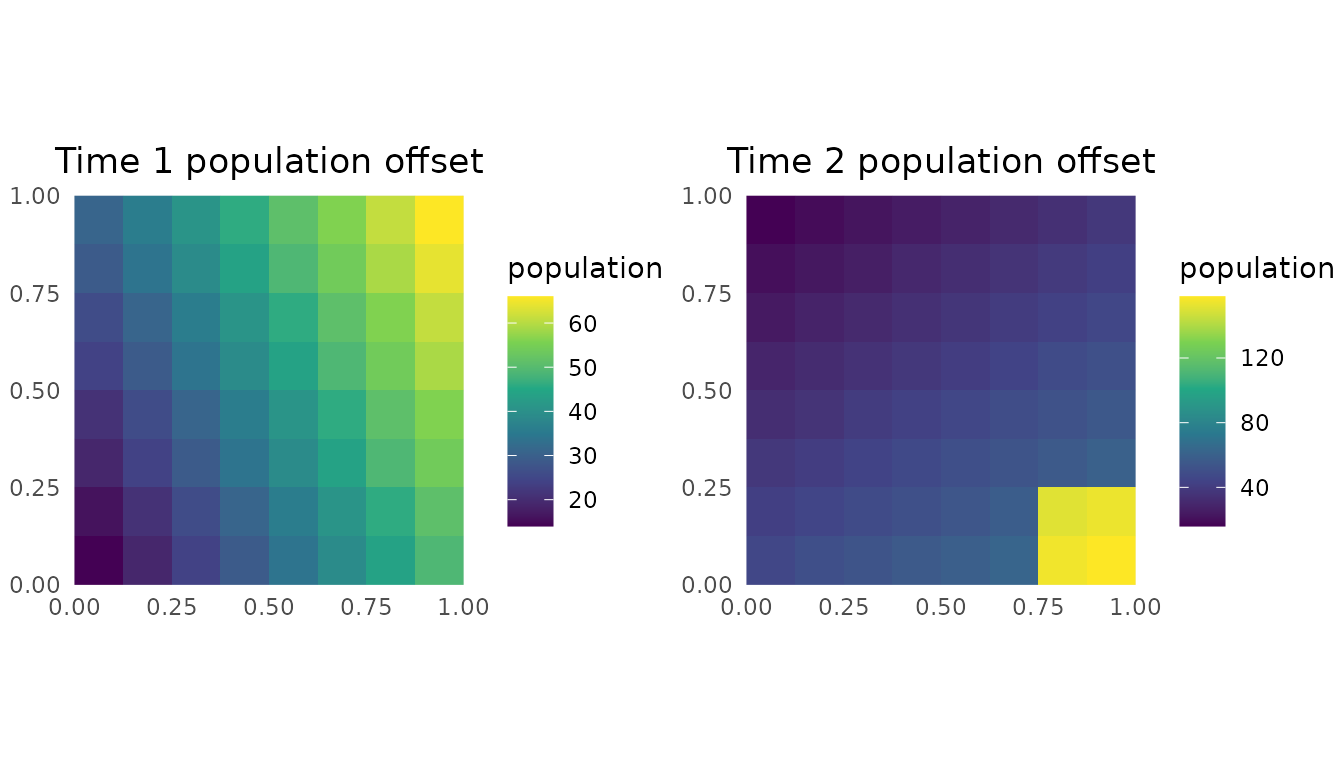
The aggregation rasters are simulated population offsets. The second time point has a higher-density pocket in the bottom-right polygon introduced by the second map. Counts are simulated on the same fine grid from a negative-binomial model, then summed into each polygon support.
set.seed(1)

template <- rast(
  ncol = 8,
  nrow = 8,
  xmin = 0,
  xmax = 1,
  ymin = 0,
  ymax = 1,
  crs = "EPSG:3857"
)
xy <- xyFromCell(template, seq_len(ncell(template)))

population_1 <- template
values(population_1) <- pmax(1, round(10 + 40 * xy[, 1] + 20 * xy[, 2]))
names(population_1) <- "population"

bottom_right_hotspot <- xy[, 1] >= 0.78 & xy[, 2] <= 0.24

population_2 <- template
values(population_2) <- pmax(
  1,
  round(12 + 25 * xy[, 1] + 35 * (1 - xy[, 2]) + 90 * bottom_right_hotspot)
)
names(population_2) <- "population"

risk <- template
values(risk) <- as.numeric(scale(
  sin(2 * pi * xy[, 1]) + cos(2 * pi * xy[, 2])
))
names(risk) <- "risk"

mean_counts_1 <- values(population_1) * exp(-4 + 0.8 * values(risk))
mean_counts_2 <- values(population_2) * exp(-4 + 0.8 * values(risk))

fine_counts_1 <- template
values(fine_counts_1) <- rnbinom(ncell(template), size = 8, mu = mean_counts_1)
names(fine_counts_1) <- "counts"

fine_counts_2 <- template
values(fine_counts_2) <- rnbinom(ncell(template), size = 8, mu = mean_counts_2)
names(fine_counts_2) <- "counts"

map_1$response <- as.integer(
  extract(fine_counts_1, vect(map_1), fun = sum, na.rm = TRUE)[[2]]
)
map_2$response <- as.integer(
  extract(fine_counts_2, vect(map_2), fun = sum, na.rm = TRUE)[[2]]
)
plot_polygon_counts <- function(x, title) {
  ggplot(x) +
    geom_sf(aes(fill = response), color = "white", linewidth = 0.4) +
    scale_fill_viridis_c(name = "counts") +
    coord_sf(expand = FALSE) +
    labs(title = title) +
    theme_void() +
    theme(
      legend.position = "right",
      plot.title = element_text(hjust = 0.5)
    )
}

cowplot::plot_grid(
  plot_polygon_counts(map_1, "Map 1"),
  plot_polygon_counts(map_2, "Map 2"),
  nrow = 1
)
plot_raster <- function(x, title, fill = names(x)[1]) {
  df <- as.data.frame(x, xy = TRUE, na.rm = FALSE)
  names(df)[3] <- "value"

  ggplot(df, aes(x = x, y = y, fill = value)) +
    geom_raster() +
    scale_fill_viridis_c(name = fill) +
    coord_equal(expand = FALSE) +
    labs(title = title, x = NULL, y = NULL) +
    theme_minimal() +
    theme(plot.title = element_text(hjust = 0.5))
}

cowplot::plot_grid(
  plot_raster(population_1, "Time 1 population offset", "population"),
  plot_raster(population_2, "Time 2 population offset", "population"),
  nrow = 1
)
Prepare and fit the model
The package workflow starts by combining the areal responses,
covariate raster, and aggregation raster into a
disag_data_mmap object.
schematic_data <- prepare_data_mmap(
  polygon_shapefile_list = list(map_1, map_2),
  covariate_rasters_list = list(risk, risk),
  aggregation_rasters_list = list(population_1, population_2),
  mesh_args = list(max.edge = c(0.5, 1), cutoff = 0.1)
)

schematic_data
#> Disaggregation data (multi-map) info
#> =====================================
#> Time points: 2
#> Total polygons: 9
#> Total pixels: 128
#>
#> Use `summary(...)` for more details.
We fit a small negative-binomial model with AGHQ. The example keeps the mesh coarse and uses one quadrature point so the vignette remains lightweight.
fit <- disag_model_mmap(
  schematic_data,
  family = "negbinomial",
  engine = "AGHQ",
  engine.args = list(aghq_k = 1, optimizer = "nlminb")
)

summary(fit)
#> There are 55 random effects, but max_print = 30, so not computing their summary information.
#> Set max_print higher than 55 if you would like to summarize the random effects.
#> Summary of disaggregation model (multi-map) fit with AGHQ
#> =======================================================
#> Family: negbinomial
#> Link function: log
#> Spatial field included: Yes
#> IID effects included: Yes
#> Betas as fixed effects: Yes
#> Quadrature Points: 1
#>
#> Parameter estimates:
#> ------------------
#> AGHQ on a 5 dimensional posterior with  1 1 1 1 1 quadrature points
#>
#> The posterior mode is: -4.037586 0.7223764 -3.85663 -2.477922 -0.2630212
#>
#> The log of the normalizing constant/marginal likelihood is: -29.35156
#>
#> The covariance matrix used for the quadrature is...
#>               [,1]          [,2]          [,3]         [,4]          [,5]
#> [1,]  0.0206686936 -1.313785e-02  0.0001812960 -0.008217572  2.212679e-03
#> [2,] -0.0131378489  2.545940e-02 -0.0010685351 -0.004978154  3.474388e-05
#> [3,]  0.0001812962 -1.068535e-03  0.9743869041  0.004511493  7.805125e-04
#> [4,] -0.0082175711 -4.978156e-03  0.0045115036  0.869272355 -2.923759e-01
#> [5,]  0.0022126784  3.474685e-05  0.0007804848 -0.292375926  7.153994e-01
#>
#> Here are some moments and quantiles for the transformed parameter:
#>
#>                         mean           sd       2.5%     median      97.5%
#> intercept         -4.0375860 8.881784e-16 -4.0375860 -4.0375860 -4.0375860
#> risk               0.7223764 2.220446e-16  0.7223764  0.7223764  0.7223764
#> iideffect_log_tau -3.8566301 1.332268e-15 -3.8566301 -3.8566301 -3.8566301
#> log_sigma         -2.4779224 4.440892e-16 -2.4779224 -2.4779224 -2.4779224
#> log_rho           -0.2630212 5.551115e-17 -0.2630212 -0.2630212 -0.2630212
Predict on the fine grid
The model prediction contains one fine-scale rate raster for each map/time point. Because the population offset enters the aggregation likelihood, not the returned rate surface, we multiply each rate raster by the matching population raster to visualize expected fine-cell counts.
pred <- predict(fit, N = 10)
prediction_rasters <- pred$mean_prediction$prediction

expected_counts_1 <- prediction_rasters[["time_1"]] * population_1
expected_counts_2 <- prediction_rasters[["time_2"]] * population_2

cowplot::plot_grid(
  plot_raster(expected_counts_1, "Expected counts from map 1", "mean"),
  plot_raster(expected_counts_2, "Expected counts from map 2", "mean"),
  nrow = 1
)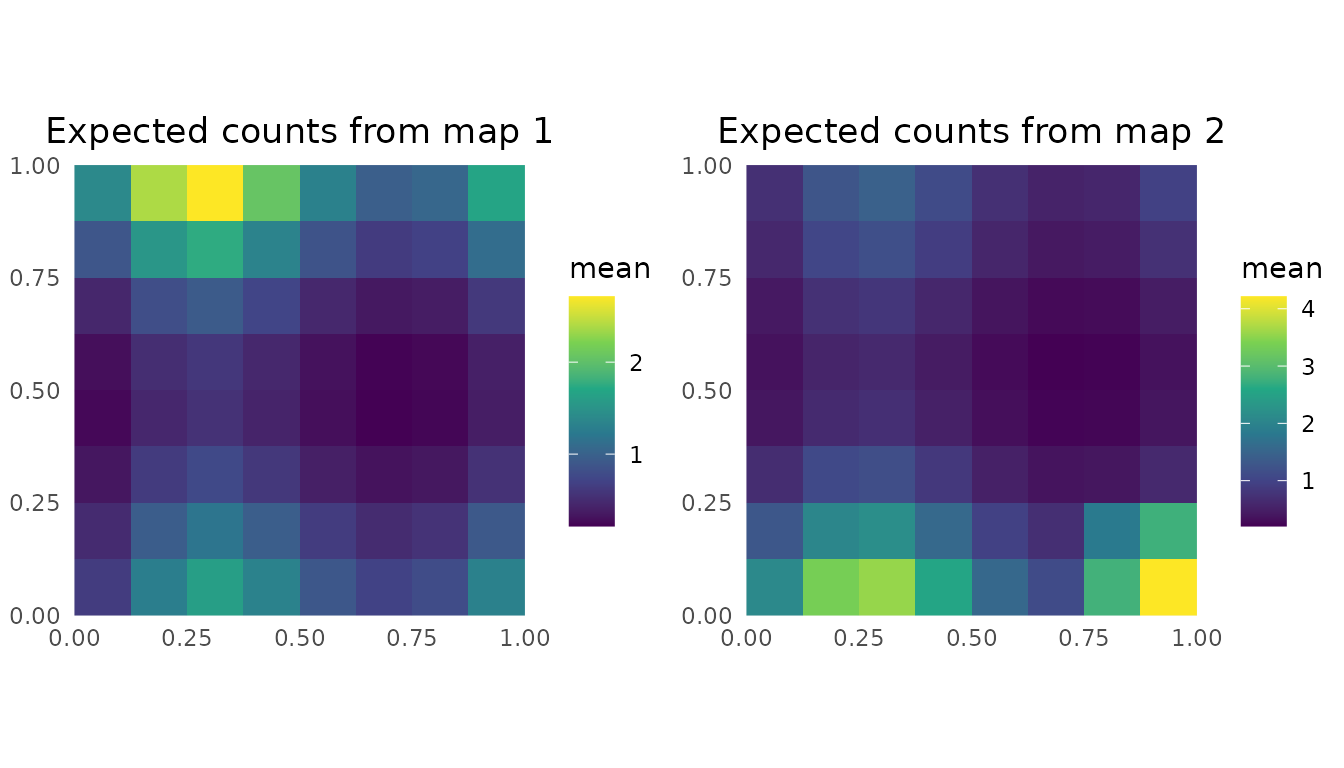
This toy example is intentionally small, but it shows the main structure: multiple areal maps, a population offset raster, optional covariates, model fitting, and fine-grid prediction all pass through the same multi-map interface.